






 EARTH
 3
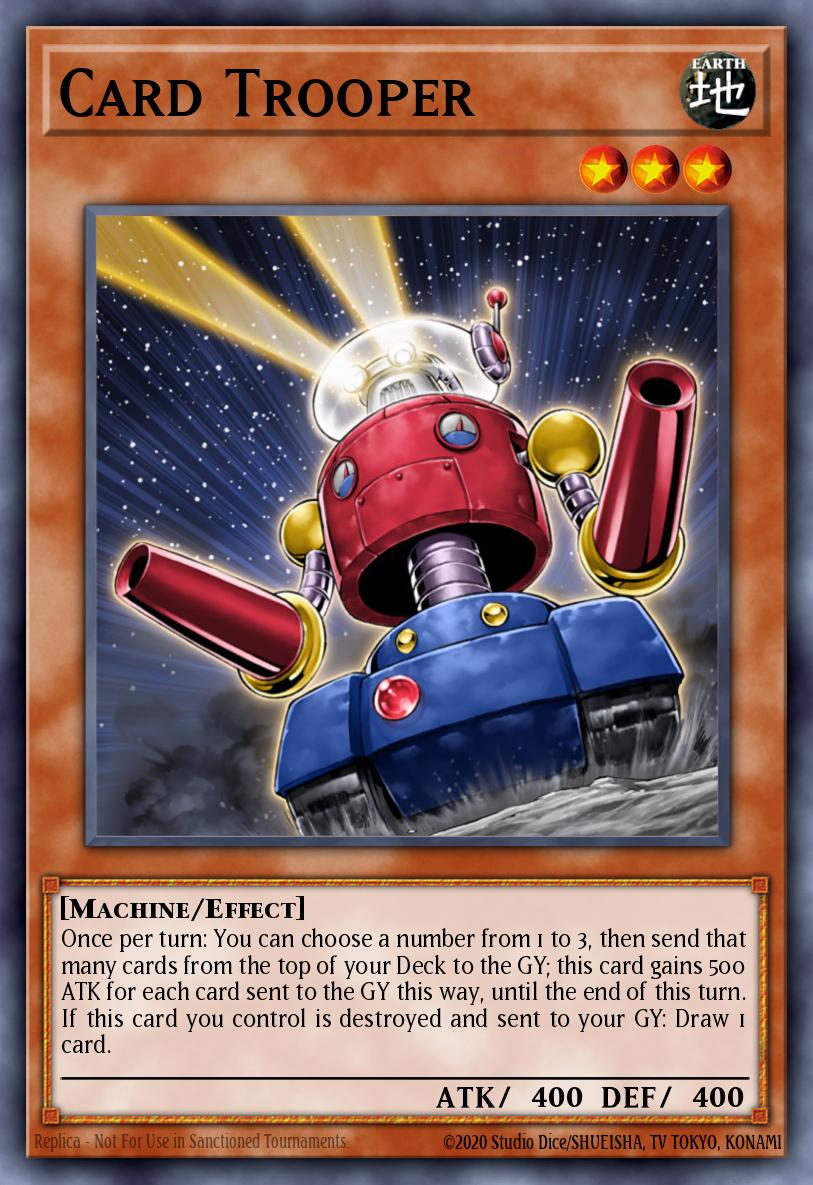
Card Trooper
ATK:
400
DEF:
400
View:
4512
Once per turn: You can choose a number from 1 to 3, then send that many cards from the top of your Deck to the GY; this card gains 500 ATK for each card sent to the GY this way, until the end of this turn. If this card you control is destroyed and sent to your GY: Draw 1 card.
Card Trooper — Power Evaluation
Final Score: 61 ± 6 · Confidence: Medium
- Intrinsic: 61 · Deck: 60 · Meta: provisional
- Primary role: Material body · Secondary: Utility
Why it scores here
Card Trooper scores as a generic Level 3 Machine body: its once-per-turn mill-to-pump and destruction-draw effects add modest value, but the card has no recorded combo role and no interaction, so it does not convert into much beyond a clean material and a cheap, splashable one-of. Its 400/400 stats earned nothing; the score comes from its presence in 400 decks across 54 archetypes at about one copy each, which confirms it is practical and easy to run, not that it is strong.
Axis scores
| Axis | Score | Evidence |
|---|---|---|
| Accessibility | 60 | Present in all 400 sampled decks at 1.24 average copies, but no combo starter or searched data exists, so live-in-hand reliability is inferred (inferred). |
| Combo & Conversion | 35 | The mill-and-pump effect can build ATK once per turn, but no recorded boards show what it converts into (inferred). |
| Resource Economy | 45 | Destruction draw gives +1 card when it is destroyed, while the mill is self-cost; no refuel or net advantage is recorded (verified from text, inferred for net value). |
| Effect & Interaction | 5 | The text has no negation, removal, or disruption clause (verified). |
| Material Utility | 70 | A non-Tuner Level 3 Machine with EARTH attribute is a generic material body, and its material value does not depend on its effect (verified from text, observed via 400-deck inclusion). |
| Resilience & Flexibility | 55 | Its draw-on-destruction clause still returns value when the body is removed, but the pump is once per turn and easily blanked (inferred). |
| Deck-Building Efficiency | 80 | Mostly one copy per deck (328 of 400), no garnet or lock restriction, and 54 archetypes accept it (observed from deck evidence). |
Calculation
Weight profile: 0.7 Material body + 0.3 Utility (multi-role blend). Intrinsic ≈ 61, Deck ≈ 60, Meta = provisional. Modifiers: none. Final formula: 0.40*Intrinsic + 0.60*Deck
Strengths
- Clean generic Level 3 material body that converts even when its effect is blanked
- Splashable and cheap: mostly one copy per deck, with no garnet or lock restriction
- Broad portability across 54 archetypes
- Destruction-draw clause returns a card when the body is removed
Weaknesses
- Pump is once per turn and needs top-deck mill to matter
- No recorded combo starter, searcher, or payoff role, so its contribution in boards is unverified
- No negation, removal, or disruption
- Its popularity is generic and does not show it is strong in this meta
Counters / choke points
- Blanking the effect leaves a 400-ATK body that is still usable as material
- Board-wide removal or monster-destruction effects that deny the destruction-draw trigger
Best use
Level 3 generic material body and cheap utility monster. Decks: Lightsworn, Synchron, Cyber Dragon, Blackwings. Suggested copies: 1.
Evidence & gaps
- Verified: Once-per-turn mill 1-3 from top of Deck gives +500 ATK per card sent this way; If destroyed and sent to GY, draw 1 card; Present in 400 of 400 sampled decks, 328 at one copy, distinct archetypes 54
- Observed: Gameplay type 7 accounts for 89.8% of sampled decks; Top partners co-occur with the card in 64% to 87% of decks, which reflects shared staples more than causal synergy
- Inferred: Acts as a generic Level 3 material body when its effect is negated; Destruction draw partly offsets the cost of losing the body; Starter and searcher roles cannot be confirmed without combo evidence
- Data gaps: no combos supplied, so combo conversion is text-only inference no banlist token, assumed 3 copies (unlimited) no usage statistics (StatisticsCard), so archetype inclusion is inferred from the deck sample only guide evidence is a general rulebook article, not card strategy